Tom's blog

Bordeaux may add grape varieties

Global warming has opened the door to additional grape varieties in Bordeaux. The General Assembly of Bordeaux AOCand Bordeaux Superieur has approved a new list of grape varieties that, if passed by the INAO, will help growers adapt to changing climate with hardier stock.

The present collection of six grape varieties will expanded by 7 more varieties. The reds included arinarnoa, castets, marselan and tourigna nacional and the whites include alvarinho, liliorila and petit manseng.

If approved, these secondary varieties cannot make up more than 5 percent of the vineyards or 10 percent of any blend. Furthermore, these grapes cannot be listed on the label.

It is not surprising that growers are seeing dramatic changes from the changing weather patterns. Grapes that flourished decades ago aren’t producing the same results as temperatures warm. Grapes are being picked later in the year and are loaded with sugar. The results are riper and more alcoholic wines.

I doubt we’ll see much change in the blends of first growths, but AOC and Bordeaux Superieur wines will quickly adapt these varieties. Yet, even they are planted next year, it will be several years before the new vines produce usable grapes.

Touriga nacional is a variety that does very well in Portugal. Alvarinho is another name for Spain’s popular albarino grape. Arinarnoa is a cross between tannat and cabernet sauvignon. Marselan is also a cross but between cabernet sauvignon and grenache. Petit manseng is grown in France along the Spanish border.
A second generation of Oregon pinot noir

For the first time, three top wine producers in the Willamette Valley have collaborated to create an incredible pinot noir from their family-owned vineyards.

Called Second Generation Vintners Oregon Originals, or 2GV for short, the 2017 blend represents the work of the second generation of winemakers at Ponzi, Elk Cove and Sokol Blosser. Luisa and Maria Ponzi, Adam Campbell and his sister Anna, Alex Sokol Blosser and sister Alison contributed fruit from each of the three families’ vineyards to make 350 cases — 140 of which were donated to charities.

It has been my experience that winemakers in this pinot noir region often collaborate even if it’s at a Friday night party. It’s not often you see winemakers sharing information. I really wonder if this project could have occurred in any other region.

The project allows the unique soil characteristics of the vineyards to come together under one wine-making recipe. The tasting of each property was done blind — but of course each winemaker could identify his or her wine. The final blend was 36 percent Ponzi fruit with the balance evenly divided by Elk Cove and Sokol Blosser.

The soil blend included Marine sedimentary soil at Elk Cove’s La Boheme Vineyard, Laurelwood soil at Ponzi’s Madrona Vineyard and Jory soil at Sokol Blosser’s Old Vineyard Block.

I’m familiar with the pinot noirs from each of these producers and they are all excellent. But, together, this wine is one of the best I’ve tasted from the Willamette Valley. Alas, given its distribution and cost ($100), you may not have a chance to taste it. It is being sold at the vineyards.

Second Generations pinot noir is a fitting testimony to the parents who were among the pioneers to settle the Willamette wine industry.

A scary turn of events

I will never understand the annual campaign to sell wine with a Halloween theme. Who wants it? Do you throw parties and look for a wine with a scary label or a name with “ghost” in it? Someone must.

Every year I’m inundated with requests to feature Halloween-themed wines. Concha Y Toro Casillero del Diablo (Devil’s Castle) at least has its brand year-round. But other brands come out of the woodwork at this time of the year. If you’re planning a party, look for labels like Apothic Inferno, Ghost Pines, Witching Hour and Vampire.

One wine that is actually worth drinking is Fora Springs’ Ghost Winery Malbec from Napa Valley. It’s a delicious fruit-driven wine made in small quantities.

Also worthy of note is Root: 1 Cabernet Sauvignon. At this time of the year it is sold ion a Halloween-esque bag.

What makes French oak so special?

At a recent tasting I moderated, a participant asked what made French oak so special. It was a good question and a timely one because I was just reading about it in Hugh Johnson and Jancis Robinson’s World Atlas of Wine.

French oak has been seen as the top source for centuries. Like vineyards impact grapes and thus the flavor of wine, the soil for trees means a lot. For instance, the Troncais forest in France produces some of the best oak for wine barrels. The soil is terrible, so the tree grows slowly and produces a wood that is tightly grained. Limousin oak, on the other hand, is wide grained and more tannic. A wine producer will choose a forest that will deliver the nuances that he is trying to create. In fact, many producers will actually choose the specific tree.

Oak isn’t the only wood used in barrels. Hungarian oak is admired for its nutty flavors. American oak, mostly from Missouri, is commonly used in Spanish wines and is noted for its aggressive tannins and vanilla flavors.

The best world atlas of wine

During my first visit to France, I brought along a copy of The World Atlas of Wine, a collaboration by Hugh Johnson and Jancis Robinson. It was instrumental in helping me to understand the villages, the wine and the landscape of Burgundy, Champagne, Provence, Alsace and more.

First published in 2003, the 8th edition of the atlas has just been released.

It was fascinating to see the changes. The previous editions didn’t have much to say about climate change or even bottle closures. And, there are more pages devote to remote wine regions such as China and Croatia.

Johnson and Robinson are among the most respected wine journalists in the world. Their painsaking effort to provide a condensed yet concise record of the wine growing regions of the world are evident to anyone who reads this book.

Johnson also published his revised “Hugh Johnson’s Pocket Wine Book 2020.” It’s much lighter and easier to fit into a suitcase. I’ll be taking it with me to France next year. Meanwhile, the World Atlas of Wine is a book that you should have on your shelf. It’s a great present too.

Josh dips into hot prosecco market

Call me a neanderthal or, better, a romantic. But I always liked that real zinfandel comes only from California and that Rias Baixas is the only wine-growing region that can make albarino. Prosecco? Veneto, Italy, right? Who else grows glera grapes anyway?

So, when I saw that Josh Cellars added prosecco to its impressive array of value-priced wines, I was taken aback. How could they? Well, first, the grapes are coming from Veneto. Winemaker and owner Joseph Carr is simply riding the coattails of a successful sparkling wine. But can’t we all just leave prosecco to the Italians and albarino to the Spaniards?

Egads, is nothing sacred any more?

In fact, nothing is. Cupcake and other producers are making prosecco. And, there are producers who are putting their labels on wines made abroad. Gallo has been distributing wines made in Europe for decades, but you won’t find Gallo on the label. That seems to be a smarter marketing tactic. I would imagine many consumers wouldn’t drink a prosecco made by an American producer because, well, it’s not a part of the romantic Italian culture.

What do I know?

Late harvest zin: how sweet it is. Not!

A dear friend shared with me his last bottle of 1968 Mayacamas Late Harvest Zinfandel. What a treat. While many late harvest zins are vinified sweet, winemaker Bob Travers vinified this one dry. Travers is a legend in wine making and this 51-year-old wine demonstrates why.

Despite its age, there was still a freshness to the fruit with raspberries and blackberries most dominant. There was just a trace of the raisiny character you would expect from an aged zinfandel. With 17 percent alcohol in this giant of a wine, there was still a lot of bottle and just some fine tannins. Although some critics, including Robert Parker Jr., suggest this wine can last another 20 years, I thought it was drinking perfectly. Long, long finish and a touch of spice.

It always blows my mind to find such great California wine that has survived this long.

A gut reaction

As if we don’t have enough reasons to consider wine a healthy elixir, now comes a study that shows wine increases “gut microbiota diversity.” Don’t worry, that’s good. It’s probably the same thing yogurt does for your stomach.

Published in the journal Gastroenterology — you subscribe, don’t you? — researchers with King’s College in London found that red wine provides better gut health than white wine, beer, spirits, and cider. The study was done on 918 female twins living in the United Kingdom.

This is amazing for one particular reason: 918 twins agreed to participate in a study!

What a lousy development

The Walla Walla Valley Alliance is reporting that the dreaded root louse, phylloxera is showing up in Walla Walla vineyards. Reports say the louse, which devastated vineyards in Bordeaux and later in California, has been present in the state since 1910 but no one has seen it in Walla Walla until now.

Earlier reports show that it also is in the Willamette Valley.

The colder climate in the Pacific Northwest is too cold for the root louse, but global warming has made temperatures more hospitable. That explains much of the spread.

None of this news means the end is near for either wine region. The spread of the root louse is easier to contain today that it was in the last century. Quarantine is usually the best solution, but no grape grower wants to admit their infection. Phylloxera takes 10-15 years to ruin a vineyard as the louse slowly sucks nutrients from the roots.

What this does prove, however, is that there is risk associated with small Walla Walla producers who develop their own root stock. Those developed by nurseries, for the most part, are phylloxera resistant and come with a lot more science invested in their creation.

Global warming making changes

If you want evidence that climate change is affecting European vineyards, look no farther than Beaujolais.

The region known for its fruity gamays is hitting harvest about two weeks early — one of the earliest since 1988. Climate experts say hotter and drier conditions will become part of the norm.

Warmer weather usually leads to wines with higher alcohol, but drier can mean significant differences in flavor too. I wonder if Beaujolais producers will have to consider growing something besides the traditional gamay. Syrah? Primativo?

Even Burgundy producers are worried. Who’s not worried are the new winemakers in Wales!

Semillon: the forgotten grape

When I first started to write about wine in the 1980s, I remember drinking a Kalin semillon from California like it was yesterday. Semillon is rarely made without a companion grape, such as sauvignon blanc. Many vintners find it one-dimensional and lacking acidity. However, in a blend it can often the natural acidity of sauvignon blanc.

The other day I enjoyed a semillon from Tyrrell’s Wines, an Australian producer in the Hunter Valley. Australia is actually one of the few wine growing regions that produce a number of semillons. The Tyrrell was very simple, but revealed that lush character for which the grape is known.

If you are in the mood, semillon is worth an adventure.

I Ott not be surprised

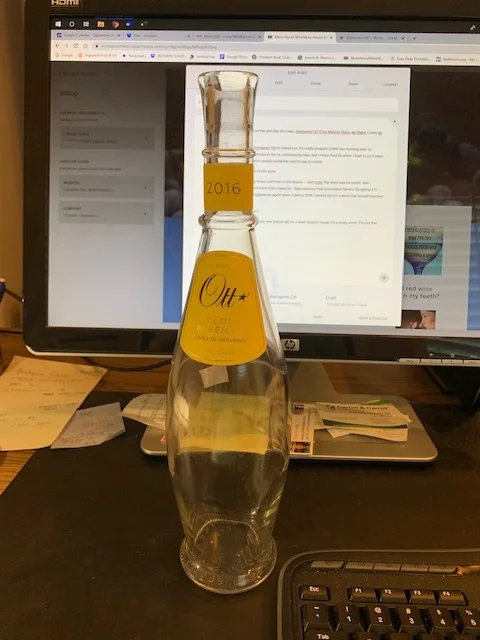
There it was on the shelf standing by itself on the last day of a sale: Domaines Ott Clos Mireille Blanc de Blanc Cotes de Provence. Why didn’t anyone want it? Was it calling for me?

IMG_1317.jpg

It’s not hard for any bottles of Domaines Ott to stand out. It’s oddly shaped bottle has nothing else to compare. I’ve marveled at this producer for its outstanding rose, but I never had its white. I had to try it even though a single bottle of any wine usually portends bad things to come.

I just wish there had been more of this wine.

Made from semillon — a variety more common in Bordeaux — and a little rolle, the wine was so exotic with generous stone fruit aromas, and fresh fruit character. Ripe passion fruit and peach flavors lingered on the palate. By aging it in large wood casks, the patina suggests an aged wine. It was a 2016 I tasted but it’s a wine that would improve in several more years.

Now, I’m on the hunt for more of it.

Note to self: just because there is only one bottle left on a shelf doesn’t mean it’s a lousy wine. It’s just that someone overlooked it.

Those Andorrans drink a lot of wine

I’ve always been amused by the little known fact that the Vatican has the highest per capita consumption of wine in the world. No other country comes close — until recently.

The new top dog in wine consumption is Andorra.

You’re probably thinking the same as me: where in the hell is Andorra? And, it’s a country?

The Principality of Andorra, as it likes to be called, is a 181 square miles patch between France and Spain in the Pyrennees mountains. Known for its ski resorts and tax haven, the soverign nation is the sixth smallest in Europe (OK, smarty pants, name the five that are smaller).

The 78,000 people who live there — and the 10 million who visit annually — must drink a load of wine. In fact, the population drinks nearly 57 liters a person!

The official language is Catalan, but when the people drink a lot, it’s more like Mayan.

Here’s the ranking:

  1. Andorra - 56.9 litres per capita a year

  2. Vatican City - 56.2

  3. Croatia - 46.9

  4. Portugal - 43.7

  5. France - 43.1

  6. Slovenia - 42.5

  7. Macedonia - 40.4

  8. Falkland Islands - 38.5

  9. Switzerland - 37

  10. Italy - 34.1

Sacre bleu, French looking for more rose?

The Telegraph recently reported that young French people are abandoning the red wine from Bordeaux in favor of light whites and roses. The 6% drop in sales of Bordeaux has led producers from France’s most elite growing region to start pushing their white wines. Very few of them make rose because, well, rose is so declasse.

In fact, young people in France say they drink wine as an aperitif rather than with meals.

Said Louise Descamps, 28, an assistant television producer: “It’s a change in lifestyle from our parents’ generation. They used to drink mainly red wine at dinner, but we tend to drink more at bars or parties. My friends and I drink more rosé or white. I still enjoy reds from time to time, but only ever with dinner.”

Rose sales have tripled in France in the last two decades; they now account for a third of the wine sold in France.

Imagine that? French Bordeaux and Burgundy were the most desirable wine among the French for generations. Today, however, not only has per capita wine consumption decreased dramatically, but so has the desire for the country’s most prestigious wines.

I can’t imagine Bordeaux producers making rose out of their merlot and cabernet sauvignon, but who knows? First-growth rose anyone?

Not surprisingly, many experts are scoffing at the ntion of Bordeaux changing direction. Wine critic Yohan Castaing told the Telegraph: “It’s not because rosés made in other parts of France work well that they’ll work in Bordeaux. They’re not really part of Bordeaux’s DNA.”

Back to Bern's Steakhouse

Most people who are deep into wine have made the trip to Bern’s Steakhouse in Tampa, Fl. It’s equivalent to Mecca for those who appreciate an aged wine alongside a good steak. Opened in 1956 by the legendary Bern Laxter, it has been filling the house for decades for those who enjoyed dry -aged steaks. .

Bern loved his wine and amassed a collection so huge that he needs an adjacent warehouse to store them. The list, once chained to the table after it began to disappear, is so extensive it would take days to peruse it.

I’ve frequented this place a half a dozen times and it never fails to please, but I learned a valuable lesson the last time I was there with my wife. I enjoyed a 2010 Marsanny and a 1998 Beaulieu Vineyard cabernet sauvignon from the restaurant’s extensive wine-by-the-glass offering. Where can you find wines like this by the glass other than at Bern’s? Both were around $22 a glass, which I thought was reasonable for their age.

We decided to order a bottle of wine for dinner and I decided to let the waiter — who said he was a “sommelier” — find something special within a $100-150 price range. He was gone forever and, frankly, didn’t give it much attention. He came back with two wines from the Rhone Valley — one I didn’t even recognize and the other was a 2008 Jaboulet Crozes-Hermitage. I enjoyed this wine for decades but questioned whether it was still good. I decided to trust his assurance.

The wine was actually fine, but I remarked to my wife that I was surprised that this was the best he could do. Afterall, it’s an average wine and the budget I gave him was reasonable. The list was extensive and I didn’t restrict the region.

He said something that annoyed me. He said the top sommeliers protected the best wines for its regular customers. The waiter said if a customer liked a particular wine, they would declare it off limits in case he wanted it again. Now, I get that regular customers who patronize the restaurant year-round deserve better access to the best wines. But here’s the lesson for me: pick my own wine.

I was entirely capable of finding my own wine and I knew I could have done better. But I thought the waiter (who said he was a sommelier of some level) knew what was really showing well.

If you go, pick your own wine.

Sacre bleu, not French wine!

President Trump is threatening to impose a tax on French wine shipped to this country in retaliation for France’s new tax on digital companies. The French tax would include Google, Amazon and Facebook — none of which are allies of the president but American companies nonetheless.

The war of words could mean that American consumers will pay more for their beloved French wine, but how much more is unclear. Those who favor French Bordeaux and Burgundy probably will not be discouraged by a small tax increase. Less wealthy wine consumers aren’t buying French wine anyway.

The only remarkable event here is that Trump doesn’t drink so it is rather ignorant for him to proclaim that American wine is better. I won’t get into that circular argument, but really, Trump should just stick with the argument that this is a counter-measure, not an issue of which country produces the best wine.

Thinking outside of the box

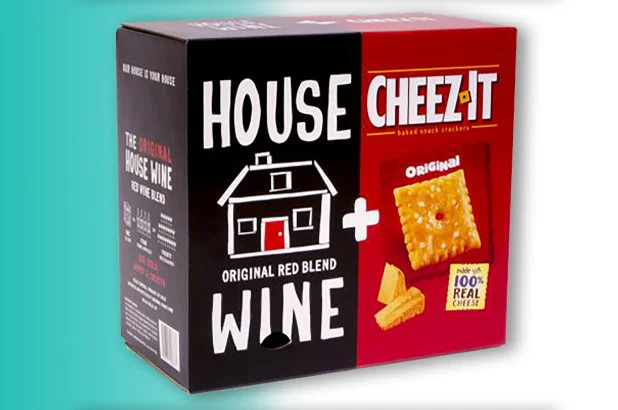
So, you know about wine in the box, right? And you get your crackers from a box, right? Now, how about it if you could get both in the same box? WOW, Tom, this is the best thing since sliced bread!

cheez it.jpg

Kellogg Co. is released a special wine/cracker box on July 25 that pairs a red blend of House Wine cabernet sauvignon and merlot with its addictive Cheez-its. I haven’t tasted the wine — and probably never will — but I suspect its quality is on the same level as Original Cheez-its. I mean, I can’t stop eating Cheez-its, but I wouldn’t serve them alongside a Bordeaux.

The wine serves 20 pours, which is quite generous. The package costs $25.

The sale begins at 5 p.m. on the House Wine website.


Yes, it's the same wine

I wish I had a nickel for every time someone claimed that a wine they had at home was not the same as the wine they tasted at the winery. They suspect that there was some hanky-panky going on.

“You know, I bet they pour really good stuff at the winery to suck you in. You buy a case when you get home and it’s not the same wine! They did a switch-er-roo.”

Nah. Here’s why the wines don’t taste the same:

You were on vacation in Napa and Chateau Blotto was the third stop of an afternoon blitz. You were enjoying the view — the vineyards, the barrels and the woman pouring the wines behind the counter. You have this tasting sheet in front of you and a place to mark down how many bottles you want. The wife agrees the Blotto Single-Vineyard Fruit-gasm is the best wine she’s ever had in the world. Of course, you want to ship home a case!

Now, you’re having a pasta — the same one you’ve had for the last decade — and you pull out a bottle of Blotto’s Fruit-gasm.. Wait, you say, why does this taste like vinegar?

Setting has everything to do with how a wine tastes because what we see and feel is as much a sense as taste. Our environs can create a special mood in which the wine is as delicious as the experience. It’s the same wine — but the place isn’t as special at home.

I caution people to be careful about buying wines when they travel to wine regions. It is easy to get carried away and join a club or ship back wines. I’ve been sucked into this trap as well, but now I limit myself and buy only a handful of wines that I know aren’t distributed anywhere beyond the tasting room. I pay a lot for these wines, but I have a high standard to meet.

Enjoy the wines while you are there but remember that place has everything to do with the pleasure.

Canned applause

I’ve been dreading the urge to write a column about canned wines. I saw it more of an obligation than a desire to learn of the latest fad. I mean, didn’t we go through this with boxed wines? And screw tops?

Well, I did it. It didn’t take me but 15 minutes to blaze through about 20 of them before I felt comfortable saying I didn’t really like them. Sure, they are as convenient as a bag clip. You can toss them into a cooler and smother them with ice and then hand them out with the beer and soda — oops, don’t give the kid one instead of the Pepsi!

But, geez, I couldn’t get past the taste of aluminum. A straw didn’t help. A glass helped, but if you can’t haul a glass bottle to a picnic, why would you take a Riedel? Maybe I’m a fuddy duddy about cans and boxes, but I just can’t look at my cellar and see stacked cans.

Those who do like them had better be careful. The 375ml cans are half a bottle and pack more alcohol per volume than beer. Don’t think you can chug this stuff and not feel pain in the morning. Some cans are only 250ml and 175ml, so that’s an improvement for someone who wants to minimize their intake.

Despite my thoughts and many of yours, I’m sure, sales are increasing. Canned wine represents only 1 percent of wine sales, but the market is growing. So do warts.

German wines are not kaput

I just returned from a cruise on the Rhine and Mosel rivers. Looking up at the vineyards on death-defying mountainsides gave me a greater appreciation for wines that I often find ho-hum.

One vineyard on the Mosel is on a 65-degree incline, making it the steepest vineyard in the world. There are more deaths among vineyard works in these regions than, say, the flat lands of Bordeaux. Occasionally, I saw a track that carried tools and buckets of grapes to a road atop the vineyard, but mostly it was obvious that workers had to prune and pick the grapes by hand.

Most confusing, was an array of vineyards that went alternately from horizontal to vertical. There was no obvious explanation. Vertically planted vines would open the vineyard to significant erosion in heavy storms. Many times the vines were trained on wire, thus allowing workers to move horizontally between plants. The horizontally planted vineyards also allowed workers to move horizontally — much safer, but I can’t imagine their shin splints.