Tom's blog

Cheaper cabernet sauvignon on the way?

California continues to struggle with a glut of grapes, particularly the vaunted cabernet sauvignon. The growing crops bode well for consumers, but not necessary grape growers who are searching for buyers in a market interrupted by the corona virus.

In the last two decades, vintners have ripped out their merlot and replanted with cabernet sauvignon to address the trend to California’s top cash crop. But that change has resulted in more bulk cabernet and more coming as young vines mature.

Top producers are unlikely to make more wine because it can destabilize the lofty prices they charge. More likely, they could sell off more of their estate grapes. If they don’t have estate vineyards, it is unlikely they will buy more grapes from the glut. Cameron Hughes, who often scarves up these excess grapes, will have a field day selling wine from top vineyards at reduced prices (with the promise he won’t name the source).

Other producers of inexpensive wines will find better quality at reduced prices. Those of us who buy wines in the $15-20 category mostly likely will be buying better wine at the same price.

Caught in a jam.

Who owns the descriptions commonly associated with wine? Apparently, J&M Cellars thinks it does.

The mass producer of wine under the Butter and J&M labels is suing The Wine Group for using “bold and jammy” to describe its rebranded boxed wine Franzia. J&M has a trademark on “jam” to describe wines.

I’ll let the lawyers duke this one out, but I was puzzled to read in the Napa Valley Register that J&M Cellars is arguing that “jam'“ is not a “known or common description of wines,” according to the newspaper.

I disagree. I use “jammy” often because today’s fruit bombs from the West Coast are so jammy that you could spread them on toast. Google “jammy wines” and you come up with 469,00 hits in less than a second. There are scads of definitions from professionals.

J&M is also suing The Wine Group for using “rich and buttery” on the same grounds.

I understand this is a marketing issue. But, geesh, really? How can you trademark words that are so commonly used?

I bet no one has trademarked “cat pee,” a common description of many sauvignon blancs.

On line wine sales soaring faster than infections

New Nielsen figures show a continued rise in online and direct-to-consumer wine sales. Alcohol sales were up 25 percent in the week ending April 4 in off-premise sales. Specifically, wine sales were up 32 percent.

In a report on WineBusiness.com, Danny Brager, Nielsen’s senior vice president, said, “No one has ever seen the kind of channel shifting we’re seeing now. It’s totally unprecedented.”

The good news is that these sales are enough to offset on-premise declines. Restaurants and retail stores are still struggling but consumers are still drinking. The question is are they hoarding or are they drinking more? Time will tell. However, many consumers may stick with their direct-to-consumer ordering on line.

In the direct-to-consumer market, the average price of a bottle dropped to $42 in March, perhaps because more average consumers used the DTC method to buy their wine. Many consumers were already ordering wine through wine clubs and their favorite West Coast producers.

Washington state led sales growth, maybe because they’ve been embroiled in this outbreak longer.

Free wine seminar(s)

While we’re trapped in our houses, I’ve been been thinking about launching a virtual wine education to pass the time. I’m not a teacher nor am I a certified sommelier. However, I’ve been studying wine and writing about it for more than 30 years. I’ve learned a lot along the way and have done several wine tasting programs in the past couple of years.

If you would be interested in participating, drop me an email and I’ll put you on the list. Just use the comment feature at the bottom.

The programs will be done on Zoom. You don’t need to download the program, but there is a free version should you decided to use it on your device. You’ll need a device with a camera and microphone.

The first one will be on how wine is made. I jumped past this lesson when I first got involved in wine and then found that I needed to know more about the winemaking process if I was ever going to understand what I was drinking. How did the winemaker get that red wine so dark? How did the tannin get there? What do they mean by malolatic fermentation and sur lies aging?

Please join me for this free program — while it’s still free.

Timing could have been worse for wineries

California wine producers are fortunate that the corona virus didn’t strike during harvest. Here in Florida, many farmers have let their crops go to waste because with restaurants closed there aren’t enough customers — including food banks. Fruit is perishable and has a very short shelf life. Same with grapes, which don’t ripen until fall.

Yesterday I was talking to Dana Epperson, a winemaker at Duckhorn’s chardonnay program that is made under it’s fabulous Migration label. She said her team is engaged in determining the blends for the 2020 wines. She and another winemaker take home beakers of various chardonnays, then taste them together virtually. Life goes on.

Epperson said it would have been far different if the crisis struck during harvest. Maybe they could have found enough pickers, but could they have processed the grapes without close contact? California was pretty restrictive in distancing.

Other wine growing regions — South Africa, South America, Australia, New Zealand — aren’t so lucky as they head into their peak harvest season. Their governments have allowed them to remain open as an essential industry, but they have to restrict the number of personnel involved in vinifying the grapes.

Let’s hope this crisis is over by September.

Pantry stuffers boosting wine sales

Nielsen reports are showing wine sales that are running equal to holiday weeks, such as Christmas and Thanksgiving. Except for champagne — what’s there to celebrate? — wine sales for the weekend ending March 21 are up 66 percent.

No matter how good the business, merchants are worried that the market will experience a dramatic swing of the pendulum once the corona virus abates. The current splurge is what they call “pantry stocking.”

Even though restaurants are experiencing a dearth in sales, retail merchants have picked p the slack. And, those producers with robust on-line or club sales are in a better position to weather this crisis.

Wine producers giving back

I’ve been very impressed with the wine producers who are giving back to their employees and others during the COVID-19 crisis. All the major conglomerates — Constellation, Gallo, for instance — are making major contributions to disaster relief.

Consumers can help too. In my community, a lot of retailers are still open and offering hands-free, curbside pickup with incredible sales. Perhaps the most impressive are the restaurants who offer food and wine packages. Restaurants often get wines that retailers cannot get, so it would be wise to see what they are offering. One restaurant in my community is selling wines at retail prices — half the price they sell it for in the restaurant. It goes to show you the huge markup they get for table-side wine.

I’ve had a couple of virtual tastings with friends last week. Ironically, two of us even chose the same wine — an obscure blend of Italian grape varieties called Zenato Alanera Rosso. What are the odds? It was great to share notes of this delicious wine.

This week my wife and I will share the screen with another wine-loving couple. We’re getting the wines and food from the same restaurant. Even if we can’t get together in person, we can still have a great conversation over food and wine.

Sonoma restaurants pitching in

SANTA ROSA, Calif. (March 31, 2020)—Sonoma Family Meal, a disaster-focused non-profit providing chef-made meals to those in need, announces the creation of the Restaurant Disaster Relief Fund—a new initiative to help restaurants remain open for disaster-relief cooking by providing healthy, chef-made meals to those in desperate need of food. John Jordan, the owner of Jordan Winery, and the John Jordan Foundation have made a $150,000 investment in the fund, and the non-profits are teaming up for a match drive to raise an additional $150,000.

“With many businesses shuttered, demand for prepared meals is at an all-time high due to the Coronavirus pandemic,” said Heather Irwin, founder of Sonoma Family Meal. “If we reach our goal of $300,000 to fully fund this program, we will be able to pay at least 20 restaurants and caterers to produce up to 100,000 meals for thousands of seniors and families facing food scarcity over the next four months.” SFM hopes to put at least 100 restaurant workers back on the payroll, keep restaurants operational, support hard costs and create income to reopen in the future.

Gerard’s Paella in Santa Rosa, the Girl & the Fig in Sonoma, Chacho’s Catering in Windsor and Preferred Sonoma Catering in Petaluma are the first four restaurants operating as relief kitchens for the new disaster relief fund.


“These meals mean that our staff will have hours and normalcy in their lives right now,” said Petaluma caterer Amber Balshaw of Preferred Sonoma Catering. Her company is producing more than 600 meals per week for Sonoma Family Meal’s clients. The initiative also helps support small family farms and local food producers by purchasing their products for use in restaurants. 


To make a donation, visit https://sonomafamilymeal.networkforgood.com/projects/96348-jordan-foundation.  

To apply as a restaurant, visit https://www.sonomafamilymeal.org/for-restaurants/


The $150,000 investment from Jordan will allow SFM to keep the doors open at least 12 struggling restaurants and caterers throughout the county currently providing meals, purchase 42,000 to-go containers (compostable or reusable) and provide 65,000 meals. Irwin estimates that SFM needs $300,000 to add at least 20 restaurants and food purveyors, expand our relief network and continue to provide services until mid-June, the projected time frame of increased need during this crisis.


“The owners of successful businesses have a responsibility to help those less fortunate throughout the years,” said John Jordan, who started his foundation in 2012. “But during times of crisis, we have to lean in and find ways to do even more.”

Drinking in place rising

As more and more states lock down, liquor stores and wineries are benefiting. You’d think Probation was about to return.

Like in any catastrophe, being confined to a home drives sales of alcohol just like they drive sales of toilet paper. When I lived in Maryland, a snowstorm set off an avalanche of alcohol sales. One store told me that the threat of three days of snow and an imminent disaster declaration resulted in his highest per-day sales. The threat of a hurricane had the same effect now that I’m in Florida. But, a snowstorm and hurricane are local. A national pandemic drives alcohol sales nationwide.

Several weeks into the pandemic, liquor stores are reporting strong sales. Nationally, sales of wines priced $15-20 were up 42 percent. Wines priced $20-$25 soared 75 percent. People hunkering down in the face of death aren’t drinking cheap wine.

Large wineries were reporting that grocery chains and big liquor stores were stocking up, so their large inventories may result later in a fall off as the pandemic eases. Bu people are definitely drinking what they buy. In San Francisco alone, alcohol sales are up 42 percent.

Also good for small wineries, direct-to-consumer sales were up. More people are joining wine clubs and ordering wine directly from producers. The ease of getting wine delivered to homes and the ability to avoid stores is more attractive than ever.

Producers and their marketing teams are coming up with creative ways for people to participate in wine seminars from their homes.

Segura Viudas is pushing its cava to enjoy while taking a virtual tour of The Museo Reina Sofia in Madrid. You can have the wine shipped via wine.com.

Oceano recommends its pinot noir and chardonnay while live streaming performances from The Metropolitan Opera. Its owners Rachel Martin and Kurt Deutsch are passionate about wine and theater. You can order their wines at oceanowines.com.

Far Niente and Nickel & Nickel are using the Zoom app to set up private or group virtual tastings for those who order wine shipped to their homes.

Hamel Family wines are selling “At Home with Hamel Family Wines,” a virtual tasting experience led by a professional via Zoom or FaceTime. Several packages of wine, ranging from $200 to $375, are being offered at its web site.

JUSTIN and Landmark Vineyards are also offering virtual tastings with Certified Winery Educator and Sommelier Jim Gerakaris with any wine order.

Remembering wine experiences in a time of stress

It’s easy to get consumed by the misery of a pandemic. Even if you are among the lucky ones with no infections in your family, the mental stress of waiting for something to happen is difficult. Although there is risk associated with turning to alcohol for comfort, it is probably safer than going shopping.

Since the pandemic broke and my wife and I have been self-quarantined with no signs of infection, the highlight of the day has been dinner. We’re eating well — as if there is no tomorrow, in fact. Today is lobster; tomorrow is steak. I’m dipping into my cellar for wines that may not be at their peak maturity — but wines I’m not waiting around the to enjoy. There are several Bordeaux wines from the 2003, 2004 and 2005 vintages, for instance.

I am choosing wines that bring back memories from better times. This week I opened a 2005 Beau-Sejour Becot. I was in St. Emilion about that time and met with Juliette Becot, daughter of current owner Gerald Becot. The father was running Beau Sejour Becot, but had just bought Juliette a vineyard and gave her a pair of boots to show him what she could do. He didn’t think she was ready to make wine for him.

I brought back a couple of bottles of Joanin Becot (I think it was her grandmother’s name) and enjoyed them. Now, Juliette is working with her brother on all of the wines, now under one roof. I guess the boots were used and Juliette earned her father’s confidence. Juliette confessed to me then that her brother helped her make the Joanin wine but she was fighting to earn respect from the men in the family.

As I enjoyed the 2005 Beau-Sejour Becot, I remembered my afternoon with her. It was a great memory to have as my wife and I sipped a perfect wine.

Just as the virus hit our country, I was at a wine store and my eyes landed on a Condrieu. Again, a flood of memories came back. The Rhone Valley village of Condrieu was an unexpected highlight during our first visit to France in the 1980s. We stayed at a delightful Relaix et Chateau and sipped a Guigal Condrieu white on our balcony. It was my first experience with a good Condrieu. The viognier grown here on steep hillsides creates intense, powerful wines.

So, of course, I bought the Faury Condrieu and gulped at its $75 price. But, I opened it the other day and remembered our first visit to France. Priceless, as they say.

We were with Pat Darr and his wife just as the crisis hit our shores. Pat writes the weekly wine column with me. We have so many memories of the column since it debuted more than 30 years ago. To recapture those times, I opened a 2005 Mastraberandino Radici Taurasi (we tasted with its winemaker many years ago) and a 1982 Chateau Gruaud Larose (we each bought this wine as futures).

Do you have a wine in your cellar that evokes a good memory? Don’t wait any longer. You never know what tomorrow will bring.

French wine shops still open

In France there is nothing closer to culture than wine and cheese. Although the country closed down most commerce this week, the government allowed for 40 categories of exceptions.

According to the Washington Post, among those exceptions were wine shops, bakeries, butchers, cheese shops, fine grocers and tobacco stores.

However, out of the usual “abundance of caution” many shops decided to close anyway. Before they did, though, many were offering delivery of “survival wine packs” of six or 12 bottles of wine.

If wine isn’t your sin, you can go to the Netherlands where cannabis dispensers are open to easy the anxieties of the Dutch.

Wine producers in the United States are getting very creative with virtual wine tastings and special deals. Chateau Montelena, for instance, has put together a “Wine Shelter package” that includes a copy of “Bottle Shock” (an excellent book based on Chateau Montelena’s win at the 1976 Judgment of Paris), a mix-and-match set of wines and a complimentary wine tasting coupon to use in the future.

Wineries suffering too

You would be right to think that vines are not likely to suffer from the corona virus. But wineries will.

In the last decade, wineries have ramped up sales in their tasting rooms. Most of them have now closed their facilities to the public. Particularly hard hit will be the small producers who don’t make enough wine to distribute their product around the country through wholesalers. I’ve spoken to many of these wine producers from California to Oregon who have said that the vast majority of their wines is sold in the tasting room or through their wine clubs. Wine clubs won’t be affected unless shippers close down. But tasting rooms will be hard hit.

I’ve seen several California wine producers announce sales for those consumers living in states that allow alcohol shipments. Not only can you help your favorite wineries by ordering some wine, but you can get a good deal — especially for those wines that aren’t available in your local market. Check out the web sites to see if you can get a deal.

Making wine in Annapolis

Many years ago I drove to Annapolis, California, while touring Napa wineries. I did so because I was living in Annapolis, Maryland, and wanted to see how it compared. There was hardly anything there — certainly no colonial architecture steeped in history or bustling tourism industry that highlights the East Coast namesake.

I saw a lot of cows and apple orchards, but few vineyards. I did stop at the Annapolis Winery and tasted their wines. I was not impressed and left thinking there wasn’t much of a future for Annapolis, the wine-growing region.

Jess Jackson was buying property in this Sonoma Coast region in the late 1990s, but otherwise there wasn’t much interest for years. Today, the Annapolis region has about 20 vineyards nowadays and wineries such as Emeritus and Hartford Court are buying its grapes.

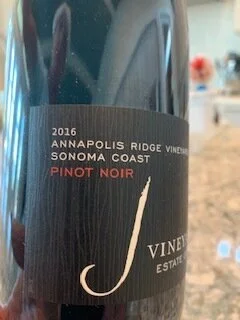
Then, the other day I came across a single-vineyard “Annapolis Ridge” pinot noir from J Vineyards. Not only was I surprised to see a $110 pinot noir coming from this region, I was surprised it was so good. The vineyard for this wine spans a rugged hillside close to the rocky shores of the Pacific Ocean. Yields are low because of the terrain. Only 600 cases of the wine are produced.

It’s a beautiful area to visit and now I have better reason to go there.

IMG_1582.jpg

Keeping an eye on pinot noir

I’ve been sampling a lot of West Coast pinot noir lately. I love the full-body, extracted fruit character of many of the premium wines, but admittedly they have skewed my vision of pinot noir. Isn’t this the same grape grown in Burgundy?

You couldn’t tell if you tasted them side by side. While Burgundy produces pinot noir that by and large are elegant and even understated, California makes pinot noir that hits the palate with a hammer. Attribute that to the difference in soil and climate — but also to the winemaker’s focus.

I recently tasted a few pinot noirs made by Maison Drouhin — some were from Burgundy but there were also pinot noirs made by the producer’s Willamette Valley center. Even though Veronique Drouhin uses the same techniques and philosophy in both regions, the wines were very different. I have always loved the Drouhin Oregon “Laurene” Pinot Noir and the 2016 did not disappoint. But it is softer and more juicy than the Drouhin Cote de Beaune Rouge.

Since 2013 Drouhin also has been making pinot noir and chardonnay under the Roserock label. From the Eola-Amity Hills AVA, this fruit-forward, vibrant wine has the Drouhin signature.

Given a choice, I like the subtlety and elegance of Drouhin’s burgundy. And, the price isn’t that much different. The “Laurene” sells for $78; the Cote de Beaune sells for $54.

Wine consumption drops in U.S.

For the first time since 1994, wine consumption in this country dropped. According to IWSR, the industry’s tracking service, Americans drank .9 percent less in 2019.

Experts attribute the decline to health-conscious millennials who have turned to alternatives such as hard seltzers, sparkling water and even non-alcoholic beer.

Sales by value rose about a percent, however, because consumers are drinking more expensive bottles.

Consumption got a boost from stories about the health benefits of wine consumption, but millennials haven’t been influenced by such an old story. Instead, they are focused on healthy foods and beverages as well as cost.

If additional tariffs are executed as early as this week, the wine industry is going to take an even bigger hit.

How about some caminante?

The University of California at Davis has released five new grape varieties that it says are resistant to Pierce’s disease, a bacteria spread by insects. Pierce’s disease is a growing threat to grape growers, costing more than $100 million in losses a year.

The grape varieties are: camminare noir, paseante noir, errante noir, ambulo blanc and caminante blanc. Hardly household words in wine, right?

According to a press release from UC Davis, camminare noir is similar to a blend of cabernet sauvignon and petite sirah. Caminante blanc has characteristics of sauvignon blanc and chardonnay. Pasante noir is like zinfandel and errante noir is most like cabernet sauvignon.

Ambulo blanc, similar to sauvignon blanc, and caminante blanc, similar to sauvignon blanc and chardonnay, are white grape varieties.

The cuttings will be available in 2021. Because it takes a good six years for a decent crop, don’t expect to see these on the market soon. Even then, the grapes will probably be consigned to a blend.

Powell doing well after leaving Torbreck

When most people think of premium Australian wine, they may think first and only of Penfold’s Grange. But the pricey, legendary shiraz is hardly the only Australian wine that excels in quality and commands the price to prove it.  

Torbreck, for one, has established a place in the country’s hall of fame. Founded by David Powell in 1994, the wines of its Barossa Valley estate were scoring awards for years. Then, Powell had a falling out with the winery’s owner Pete Kight in 2013.  Powell left the company and immediately launched a new brand with his son Callum, now 25 years old. Today, Powell & Son wines are following a similar trajectory of winning awards and spinning heads with dizzying prices. 

I had the opportunity to taste the recent releases and can attest to the 91-99 point scores they are getting. Made from grapes grown on vines more than 100 years old, the 2015 Kraehe Shiraz and the 2015 Steinert Shiraz are two of the most complex shirazes we’ve tasted but you’ll need $623 to buy one. More reasonable in price is the 2015 Powell & Son GSM (grenache, syrah, mourvedre) that sells for $58 or the Riverside GSM for $21.  

Powell doesn’t own any vineyards – he was able to win over the owners of vineyards who once sold to Torbreck. Call it poetic justice. Powell farms nearly all of the vineyards himself. He also uses old concrete ferment vats and basket pressing – a unique form of winemaking that obviously works well for him. 

Hermes and wine don't mix

It may not be a good idea to bring your Hermes handbag to the Alpine Country Club in New Jersey. Nor is it a good idea to work there.

A woman has sued the country club for spilling wine on her $30,000 Hermes handbag given to her by her husband. Hermes no long makes the handbag, thus making it irreplaceable. The country club declined to pay the woman and instead blamed it on the unnamed waiter — as if that removed their liability.

The country club initially sued the waiter, but later dropped the effort once it went public. Good thing — I doubt the lawsuit would have held up in court. There are plenty of precedents in which a company is responsible for its employees mistakes.

Strange, no?

Giving space to Bordeaux

Space Cargo Unlimited has sent a case of red Bordeaux into outer space. It’s not for astronauts to drink but it’s rather an experiment to see if the lack of gravitational pull has any effect on wine after a year in space.

A case of the same wine will be preserved on Earth so that a scientific comparison can be made.

Alas, wine wasn’t the first or only beverage to be test. Beer, scotch and other spirits have been launched a million miles away as part of a broad analysis to see if agricultural can survive in places other than here.

My imagination just wanders at the thought. Could vineyards on Mars be far away? If there isn’t gravity, how on Earth will one pour wine into the glass? Or keep it in their mouth?

Researchers have stumbled on to wine that has been unwittingly stored for centuries in amphoras, at bars in Pompeii and even at the bottom of the ocean in sunken ships. Why not space?

Rynders always lands on his feet

I met Tony Rynders in the mid 2000s when he was cutting his teeth at Domaine Serene. It was here that he established himself as a premier winemaker, especially with pinot noir grown in the Pacific Northwest.

Shortly after my visit, it was reported that Rynders was fired by Domaine Serene owners, Grace and Ken Evenstad and then sued by the Evenstads for stealing a formula for the white pinot noir he made there. They eventually settled out of court and Rynders went on to make great pinot noir for Tendril and consult for other pinot noir producers. The Evenstads, on the other hand, went on to fire more winemakers. This turnover doesn’t help the wine, which is highly dependent on a winemaker’s touch.

How Rynders was treated reminds me of a conversation I had with Grace Evenstad during a visit to Naples, Florida, the family’s winter home. They had just purchased a French winery in Burgundy. She told me the first thing they did was fire everyone. Despite that she still felt the French welcomed the Americans. I’m not so sure.

Rynders has now joined Jackson Family Wines to introduce a new line of pinot noirs from Anderson Valley. Called Maggy Hawk, the four pinots I tasted were quintessential Rynders — big, bold and expressing the unique soils of each of the four vineyards. The Stormin’ pinot noir was chewy and full bodied with blueberry character while the Jolie was silky and elegant, much like a French burgundy premier cru.

Like all great pinot noir, these wines aren’t cheap at $65 a bottle. But if that' price doesn’t scare you off, I highly recommend trying them. Rynders has the midas touch when it comes to pinot noir.